
Classroom Mathematics California

A Brand-New TK–Algebra 1 Core Math Program Designed for California

Classroom Mathematics California supports educators in implementing a core high-quality instructional materials math curriculum.

Overview

Designed to Bring the California Framework to Life

Classroom Mathematics California aligns with the vision of the California framework and its emphasis on mathematical ideas as connected and interrelated. The program is built to foster deep, connected understanding through a deliberate and flexible structure. Every lesson follows the Try–Discuss–Connect framework. This problem-based approach seamlessly incorporates multiple routines and flexible structures into daily instruction while integrating language to develop deeper understanding.

Review samples to learn more about the curriculum's rigorous, engaging problem-solving model.

  • Program Type:Instruction
  • Curriculum Type:Core
  • Subject:Mathematics
  • Grade(s):K–8
  • Language:English, Spanish
  • Format:Digital, Print
  • Copyright:2026

Program Features

Build Big Ideas across Lessons and Units

Instructional Design

The instructional design in Classroom Mathematics California reflects the Mathematics Framework’s emphasis on Big Ideas in mathematics as connected and interrelated, rather than as a series of discrete topics.

The Big Ideas in Classroom Mathematics California serve as a roadmap for both teachers and students to connect mathematical concepts across lessons and units.
Structured for In-Depth Learning
The multiple-day lesson structure provides time for California students to develop deep understanding and make connections that extend across the lessons in a unit to build Big Ideas.

Inspire Curiosity with Data Experiences

Classroom Mathematics California provides opportunities for students to build their data literacy and data science skills with Data Talks and Data Investigations that are built into the program. The resources allow students to apply and strengthen grade-level mathematics while exploring data and developing their data literacy skills.

Ensuring Access and Outcomes for All Students through the Universal Design for Learning (UDL)

All students bring assets, funds of knowledge, and variability of their learning. Classroom Mathematics California embraces the UDL to remove barriers to learning so all students have opportunities to succeed and see themselves as mathematicians.
Celebrate the Student
Problem contexts, authentic activities, and images with varied cultural representations make mathematics relevant and culturally sustaining to California students as they see themselves in the content.
Build Student Confidence as Mathematics Learners

The Try–Discuss–Connect instructional framework affirms multiple ways of approaching and solving mathematics problems. Students have access to multimodal and hands-on learning with real and digital manipulatives and math tools. The program also encourages discourse through partner and whole class discussions.

Language Routines
Language Routines, which help students learn the academic language of mathematics, support students in understanding problems. Routines are flexible and can be switched out as desired.
Protocols for Engagement

Use varied and flexible cultural communication modes to structure activities that encourage all students to participate.

Remove Barriers to Learning
Universal supports, such as manipulatives and digital accessibility features, the Student Bookshelf, and Interactive Practice, ensure all students can fully and effectively engage with the content.
UDL Implementation Support
This program provides resources to help teachers confidently integrate UDL-aligned practices into their planning, teaching, and classroom environment.

English Learners and Language Development

Classroom Mathematics California ensures that all students, including English Learners, have the support they need to engage with rigorous content and communicate their ideas effectively. Language-related features and resources address the California ELD Standards and show teachers how to scaffold instruction, so English Learners can develop the academic language they need for success in mathematics.
Connect to Language Development: Differentiation to Support English Learners

Every session includes a support continuum of English proficiency levels, focused on California ELD Standards. Differentiation speaks to specific lesson content and provides guidance for specific activities.

Encourage Home Language
The Cognate Support routine at the start of each unit encourages English Learners to use their first language to make associations to academic words.
Develop Academic Language
Develop Academic Language for all students at the word, sentence, or discourse level. Focus includes multiple-meaning words, affixes, word families, irregular verbs, unpacking and constructing complex sentences, and conversation tips.
video player thumbnail

New Live Class Experience for Grades 6–8

Back to School 2026: A seamless digital orchestration and collaboration experience.

Testimonials

With this curriculum, the hope that it gives me is that every student will say, ‘I am a mathematician. I can do math.’

— Karen Gauthier, STEM Coordinator​, Capistrano Unified School District

Related Videos

video player thumbnail

Leslie Amaro, Grade 1 Teacher, Capistrano USD

video player thumbnail

Heather Trudeau, Grade 5 Teacher, Capistrano USD

video player thumbnail

Karen Gauthier, STEM Coordinator, Capistrano USD

Our Professional Learning suite offers collaborative live sessions and curated, on-demand digital resources to help educators drive meaningful student outcomes with their Curriculum Associates programs.
Invest in Your Impact

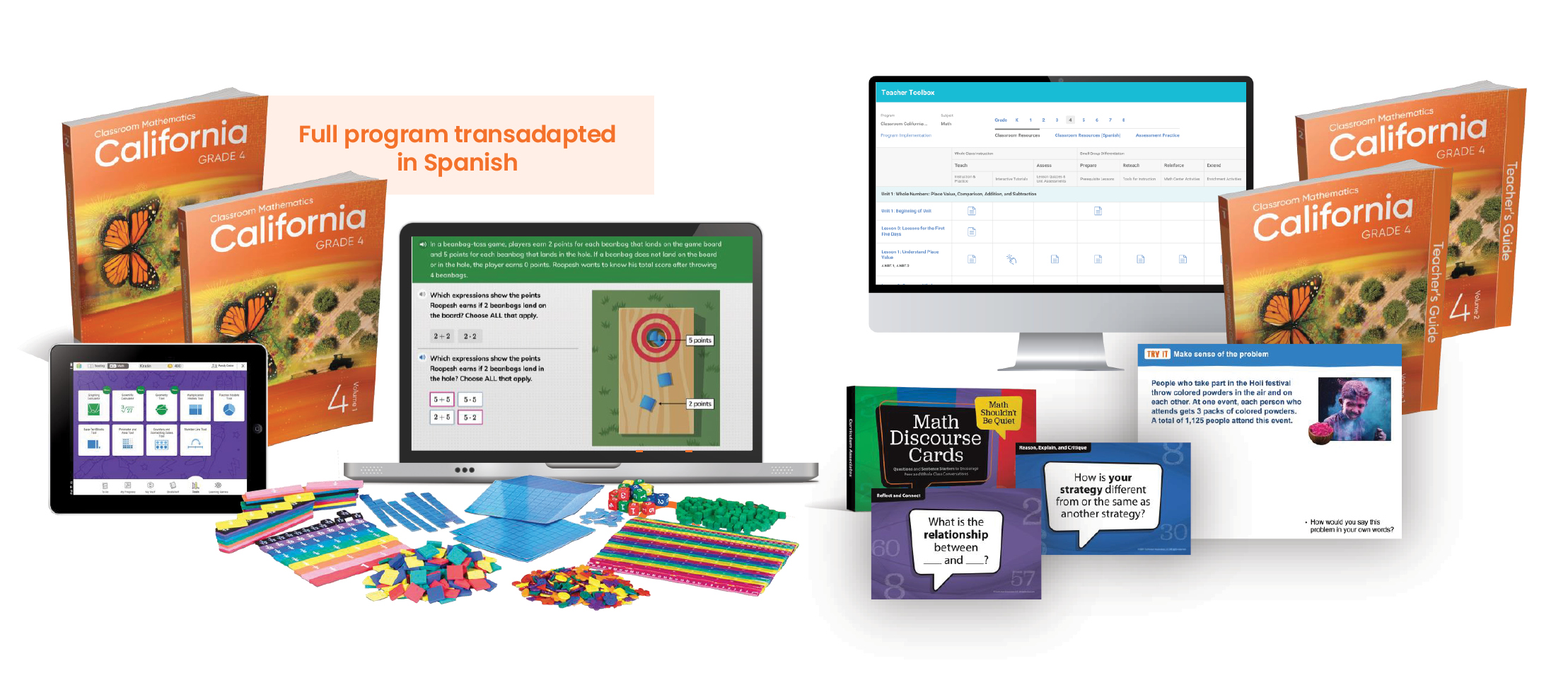
What's Included

Student Worktext (Grades K–A1)

  • Two volumes organized by units, lessons, and sessions 
  • Variety of lesson types and targeted practice problems that support conceptual understanding, procedural fluency, and application 

Fluency and Skills Practice Book (Grades K–A1)

  • Targeted fluency practice for every lesson 
  • Included on the Teacher Toolbox and available in print for additional purchase 

Student Digital Experience (Grades K–A1)

  • Digital version of the Student Worktext 
  • Family Center 
  • Diagnostic assessment 
  • Digital Math Tools (Grades K–5) 
  • Digital Math Tools powered by Desmos Studio PBC (Grades 6–8) 
  • Interactive Learning Games (Grades K–8) 
  • Fluency Flight digital math facts fluency program (Grades 2–5) 
  • Teacher-assigned Interactive Practice and assessments

Teacher's Guide

  • Best-practice teaching support for every lesson 
  • Variety of professional learning resources to support educators with every concept 
  • TK Teacher’s Guide provides 10 instructional topics, Connections to Family, Connections to UDL, Connections to Language, and Whole-Class Activities divided into sections to help teachers monitor progress based on PTKLF.
 

Discourse Cards (Grades K–A1)
Manipulative Kit (TK)
Workmats (TK)
Vocabulary Cards (TK)
TK Decks of Cards (Numerals, Dots, Numbers, Shapes, Vocabulary)
Centers Library (Grades TK–1)

Teacher Digital Experience

  • Presentation slides (PowerPoint®, Google)  
    • Available for everyday instruction aligned to the Student Worktext 
    • Big Ideas Self-Check 
    • Data Talks/Environmental Principles & Concepts (EP&Cs) 
  • Teacher Toolbox 
  • Grade-Level Planning (Prerequisites) report 
  • Math Center Activities 
  • Enrichment Activities  
  • UDL Toolkit  
  • Comprehension Check reports 
  • Assignable Interactive Practice 
  • Learning Games reports 
  • Multilingual Family Letters 
  • Unit Games 
  • Literacy Connections 
  • Unit Flow & Progression Videos 
  • Academic Vocabulary Glossary 
  • Correlation Charts 
  • Multilingual Glossary
  • STEM Stories

Algebra 1 Support

  • Extension of the core program 
  • Support students with expectations and content in Algebra 1.

Microsoft PowerPoint® is a registered trademark of Microsoft Corporation.

Designed to support the implementation of the Mathematics Framework, Classroom Mathematics California empowers educators with comprehensive resources and innovative strategies that bring the framework’s core principles to life, ensuring students not only grasp math concepts but also develop genuine excitement to learn math.

Welcome!

For a better website experience, please confirm your location.