
Metalinguistic Awareness: Building a Bridge for Multilingual Learners
3-min. read
Language transfer for multilingual learners can turn what Spanish speakers already know into a bridge, not a barrier.
3-min. read
By: Natalie Banks

When I think about what’s made the most significant difference in my teaching over the past few years, what truly helped me improve mathematical understanding for all students, it’s this: courage, clarity, and connection.
Early on, I taught math the way I was taught—whole group, one pace, one lesson for all. However, I began to notice that not all students were developing deep mathematical understanding. They weren't asking questions, they weren't showing growth, and I couldn't always tell who was struggling until it was too late.
That’s when my math interventionist introduced me to the idea of doing small group instruction first. I was hesitant initially—how would I manage the logistics? Would I have enough time? But once I tried it, I never looked back.
Now, I use the i-Ready Inform (formerly i-Ready Diagnostic), Comprehension Checks, Lesson Quizzes, and Prerequisites Reports Data to split my class into two fluid groups. I spend 15–20 minutes with each group, focusing on pre-conceptual understanding, fluency practice, and personalized feedback before addressing the class as a whole. I also pull in manipulative activities, unit games, and task-based problems to keep things engaging and meaningful.
As I facilitate small group instruction, the rest of the class builds fluency and understanding via independent work with engaging center activities and practice activities in i-Ready. This allows for personalized instruction, so all students are challenged and work on pace. Then we come back together for the remainder of the math block to learn the next session as a class.
The difference? I now have visibility into my students' understanding. I can catch misconceptions early and remediate immediately as necessary in a way that whole group only didn't allow. The result is that all students are actively participating, and as a teacher I am facilitating more effective instruction for every one of my students.
Subscribe to Our BlogOne of the most powerful tools I’ve embraced in my teaching journey is clarity. Inspired by John Hattie’s Visible Learning work, I now begin every lesson with clear learning intentions and success criteria. What are we learning? Why does it matter? How will we know we’ve learned it? When students understand the bigger picture, everything makes more sense to them, and what they’re learning resonates.
One of Hattie’s collaborators, John Almarode—professor of education at James Madison University and a respected author of several books on teaching and learning—discusses the importance of spaced practice, or revisiting concepts over time to transfer learning into long-term memory. I’ve started incorporating this into my planning—reviewing key ideas weeks later, using fluency pages, center activities, and i-Ready resources to reinforce learning.
I teach at an urban elementary school in Manhattan, Kansas—affectionately known as “The Little Apple.” Our school serves an often transient population, and my class roster changes constantly. Students come and go. Many come from low-income backgrounds, from a nearby crisis shelter, and from military families at Fort Riley. Some have experienced real trauma.
One of my students who benefited from the small group first approach lived in a crowded home with little adult guidance, and had a history of behavioral struggles. I’ll be honest: there were days I felt like I wasn’t reaching her. I worried I wasn’t making a difference. But then, during our final Diagnostic, she took the assessment in a small group setting. When I saw her score, my jaw dropped. She increased her score by 40 points from the midyear Diagnostic and surpassed her Stretch Growth® goal by six points! After everything she’d been through, she made the most progress in the class. She may not have had many celebrations in her life, but that day, she got a big one.
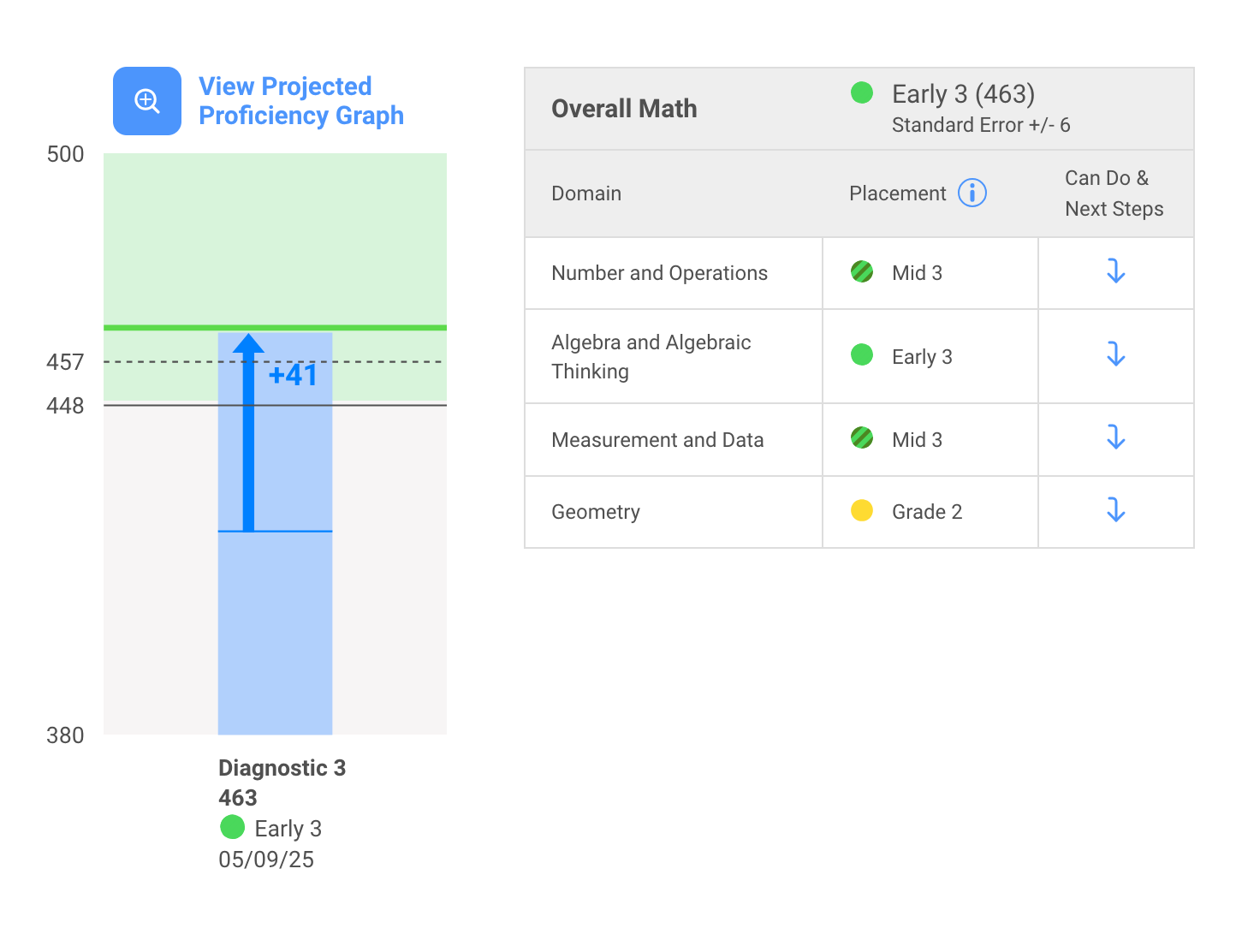
Teaching can be hard. Teaching in a high-needs, ever-changing environment can be even harder. But it’s also gratifying. Finding that “sweet spot” for each learner takes time, but it’s worth it. With the courage, clarity, and connections, we can help every student grow.
Want to learn more? Check out our discourse-based mathematics solutions.
Subscribe to our blog today!
3-min. read

4-min. read

3-min. read