
Reducing Kindergarten Retention Rates: A District's Reading Turnaround
4-min. read
How one Texas district went from high kindergarten retention rates to 88% reading proficiency in just three years.
2-min. read

Fractions can feel intimidating—for both students and teachers. If you’ve ever watched a third grader squint at a number line or try to slice an imaginary pizza into equal parts, you know the struggle is real. But with the right models and language, fractions become not just doable, but intuitive.
In my 15 Minutes of Math session Examining Fractions on the Number Line, I demonstrate how teaching fractions on a number line helps make these concepts more concrete and builds understanding across Grades 3–6.
Here are some actionable classroom moves you can try right away to build understanding.
One of the biggest “aha” moments for students happens when they realize fractions aren’t just marks—they’re spaces. When we draw a number line from 0 to 1 and partition it, the spaces between the tick marks represent the fractional parts. For example:
Once students understand that spaces create fractions, they’re ready for deeper comparisons. Try this:
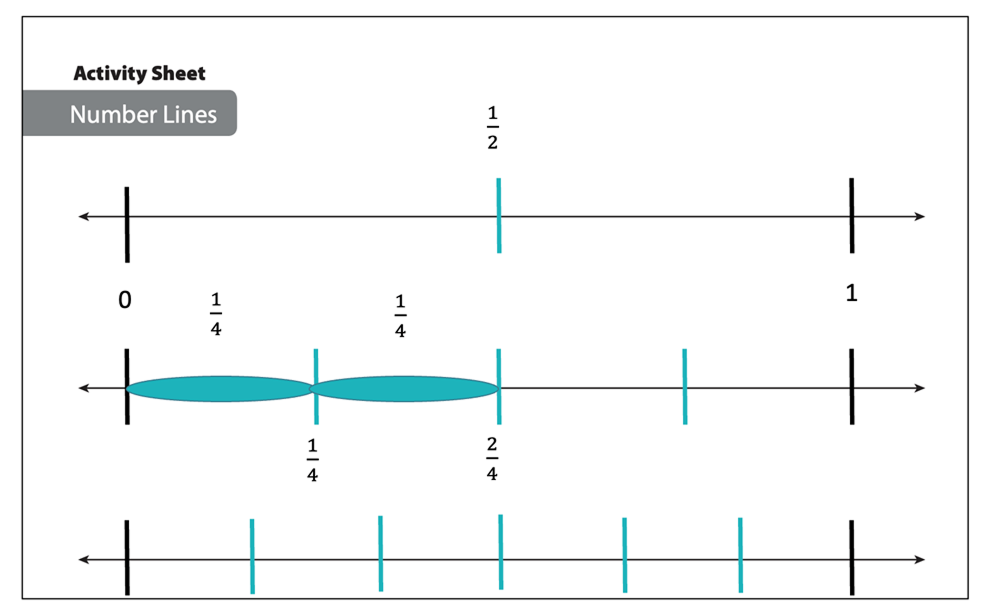
Students quickly see that equivalent fractions occupy the same spot—a powerful visual that prepares them for upper-grade computation.
Teaching Tip: Use grid paper. Because the squares are already equal in size, students can partition more accurately, especially when working with trickier denominators like twelfths.
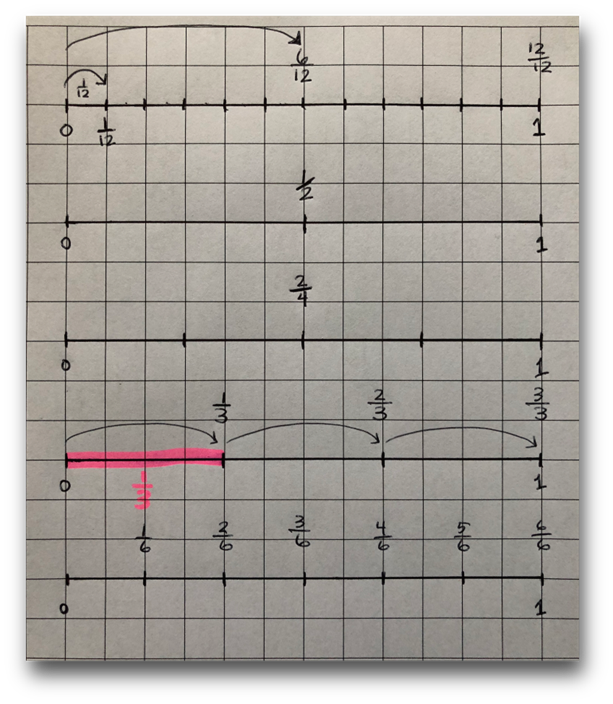
By fourth and fifth grade, students use fractions in operations—adding, subtracting, multiplying, and dividing. Number lines continue to support those connections.
For example, Josie paints 3/10 of a fence, and Julio paints 4/10 from the opposite side. Using a number line, demonstrate how to:
This mirrors how students add whole numbers on a number line, but with smaller, equal-sized steps.
When students learn whole number multiplication, we use the phrase “groups of.”
The same approach works for fractions.
For example, with a recipe calling for 2/4 teaspoon of an ingredient:
Number lines show students that multiplying a fraction by a whole number means making repeated jumps of the same fractional size.
Number lines help students see the meaning behind the quotient, not just the symbolic computation. Later, as they repeatedly partition wholes into fractional parts (e.g., dividing four pounds of blueberries into 1/2-pound portions), students discover the rule we know as “multiply by the reciprocal”—but through reasoning, not memorization.
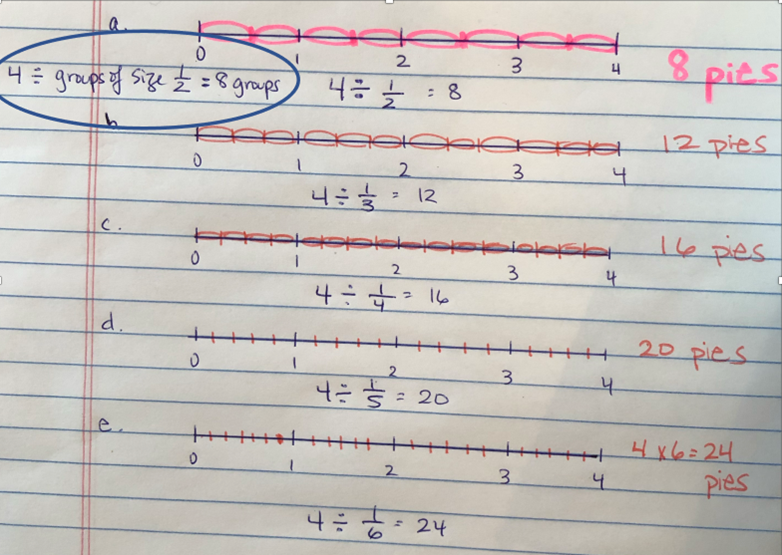
The instruction students receive in third grade (e.g., partitioning spaces, marking boundaries, comparing fractions) is the foundation they need in fourth, fifth, and sixth grade when they:
This is a progression—not a set of disconnected skills. The more consistent we are with models and language, the more confident students become.
Here are tips that will help clarify these concepts in your classroom:
Helping students travel spaces on a number line isn’t just a technique—it's a mindset. When they see fractions as distances, relationships, and patterns, everything from equivalence to computation becomes more approachable.
Subscribe to Our BlogWant more tips for mathematics instruction? Check out these 15-minute webinars:
Examining Number Paths, Number Lines, and Rulers
Examining the Standard Algorithm for Multiplication
More Resources for You:
HOW-TO VIDEOS: Using Number Lines
Incorporating Multisensory Learning in the Classroom
How One District Embraced a Problem-Based Mathematics Curriculum to Build Thinking Classrooms
4-min. read

3-min. read

3-min. read